A somewhat windly evening but I was able to capture the "Monkeyhead" nebula aka NGC 2174 ! This is 2.5 hours of integrated exposure made up of 4 minute exposures stacked in SIRIL and post processed with GIMP.
Monday, January 27, 2025
Friday, January 24, 2025
What a difference three years can make!
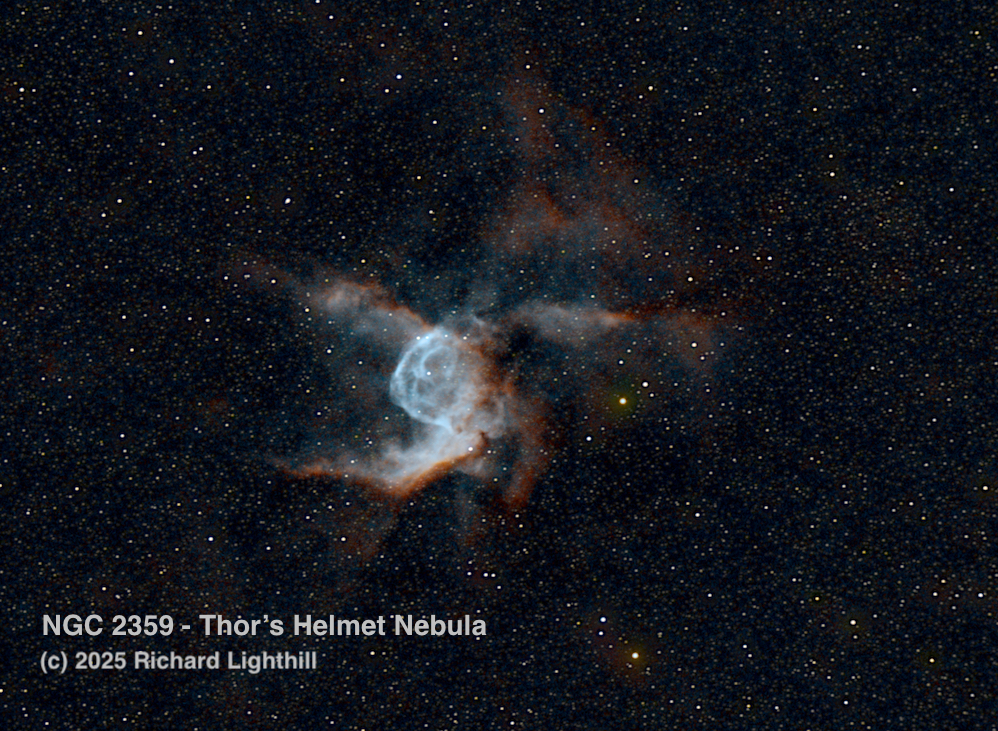
The above is the result of 3 hours of imaging on January 24, 2025 of "Thor's Helmet" nebula (aka NGC 2359) with the ZW0 585MC pro camera, post processed with SIRIL and GIMP.
Compare it to this one below which I took three years ago on January 24, 2022.:
You can see what a little more experience in imaging and processing with a better camera can do!
Monday, January 20, 2025
The "Hamburger" Galaxy
My only goal was to see how much detail a small refractor could capture in this galaxy...
...not bad but certainly limited !
Taken with:
ZWO ASI585MC Pro USB3 Cooled Color Camera
Daystar 80mm f/6 480mm refractor
About 2.5 hours of integration
Post-processed with SIRIL and GIMP
Sunday, January 19, 2025
M 78 aka the "Casper the Friendly Ghost Nebula"
Now that the Moon is no longer full I was able to spend some time imaging some of the interesting objects around the constellation Orion (which is high in the south-eastern skies when it gets dark at night right now).
This object is known as M 78 to astronomers.
Messier 78 or M78 is a beautiful blue reflection nebula in the constellation Orion. This nebula is often referred to as the ‘Casper the Friendly Ghost Nebula’.
M78 is about 1,350 light-years distant from Earth.
M78 is classified as a reflection nebula because the dust particles in this area are reflecting starlight from the intensely hot, young stars beneath it. About 45 variable stars of the T Tauri type, these young stars still in the process of formation. Due to gravity, the molecular gas in the nebula has broken up into clumps of dust and gases.
Though dim it cann be found with a smaller telescopes at low power as a hazy patch as long as you are viewing this nebula in a sky free of moonlight and city light pollution.
Photography draws out the colors the human eye cannot see. This image was created with a ZWOASI585 MC camera and a 80mm f/6.5 refractor. It is made up of 15 - 240 second exposures made into one image with a total exposure time of about 60 minutes. It was "stacked" with the freeware program SIRIL and post processed with the freeware program GIMP for the final touches.
Can you see that many stars are blocked out of view near the nebula? This is because of how thick the interstellar dust is in that area!
Click on the photo to see a larger view of it.
The "Running Man" Nebula
Taken with:
ZWO ASI585MC Pro USB3 Cooled Color Camera
Daystar 80mm f/6 480mm refractor
About 2.5 hours of integration
Post-processed with SIRIL and GIMP
Saturday, January 18, 2025
The Flame Nebula
Taken with:
ZWO ASI585MC Pro USB3 Cooled Color Camera
Daystar 80mm f/6 480mm refractor
About 2 hours of integration
Post-processed with SIRIL and GIMP
Subscribe to:
Posts (Atom)
The Region of the Clavius Crater on the Moon
I photographed this Clavius Region on the Moon's southern hemisphere this evening with a Meade LX200GPS 8" SCT and a monochrome c...
-
Windy again last night but not enough to stop me from capturing the "Fox Fur Nebula" and the "Cone Nebula"! About 2 1/...
-
Here are a few pics of my roll-off observatory and control room... (click pics for a bigger image) The path from the house to the obs... Th...
-
A somewhat windly evening but I was able to capture the "Monkeyhead" nebula aka NGC 2174 ! This is 2.5 hours of integrated expos...


