Saturday, November 29, 2025

The Region of the Clavius Crater on the Moon


I photographed this Clavius Region on the Moon's southern hemisphere this evening with a Meade LX200GPS 8" SCT and a monochrome camera. For a enlarged view, click on the photo.

The largest crater in this image is Clavius. It is one of the largest crater formations on the Moon and the second largest crater on the visible near side. It is located in the rugged southern highlands of the Moon, to the south of the prominent ray crater Tycho. It is easily identified even with standard binoculars.

It is named for the Jesuit priest Christopher Clavius who was adhered strictly to the geocentric model of the Solar System all the heavens rotate about the Earth. Though he opposed the heliocentric model (where the planets and Earth revolve aroun the Sun) of Copernicus, he recognized problems with the geocentric model. He was treated with great respect by Galileo, who visited him in 1611 and discussed the new observations being made with the telescope; Clavius had by that time accepted the new discoveries as genuine though he retained doubts about the reality of the mountains on the Moon.

Saturday, October 25, 2025

Comet Lemmon - October 25, 2025


You all have likely heard of the comet gracing our evening sky: Comet Lemmon (aka Comet C/2025 A6 (Lemmon) It is in the constellation of Serpens, in the northwest after sunset here.

This is a quickie capture of 18 minutes with my telescope and camera. You will notice that the head of the comet is glowing greenish which is the result of sunlight interacting with diatomic carbon (\(C_{2}\)) and other carbon compounds in its coma as the molecules become energized (you just had to know!)

You will also notice that the "tail" has two parts to it: the white/yellowish part is made up of the dust and rock that has been blown off the comet's head by the heating of the sun. The second part of the comet tail is the long, straight, and bluish tail that always points directly away from the sun. It is called the ion tail as the solar "wind" strips the ions and pushes them away from the sun. You may also see up in the right hand corner of the image that this ion tail is distorted. That is due to differences in the solar wind. So much for tonight's lecture on comets!

I hope you enjoy the image!

It is the result of 5 - 30 second images stacked.

Thursday, October 16, 2025

C/2025 R2 (SWAN) - October 14, 2025


C/2025 R2 (SWAN) was identified by Vladimir Bezugly in SWAN images around 2025-09-11 (visible in SWAN since at least Sep 4, with STEREO-A/HI-1 detections into late August. C/2025 R2 (SWAN) is past perihelion, which occurred in mid September 2025. On September 12 the comet will pass within 0.3 AU of the earth. It reached maximum brightness in late September.

Nothing great but just another bagging of a comet since I moved here to SV. the tail was very faint as it moved through the early night sky October 14th.

Due to the monsoon and the post-monsoon monsoon I wasn't able to capture it when it was it's brightest. Oh well...

Sunday, June 1, 2025

M51 with new astro camera!


Messier 51 aka the Whirlpool Galaxy
(Click for a little larger image)

Taken April 24, 2025 from my observatory
with the Daystar 480mm f/6 telescope
ZWO ASI585MC cooled camera
2 hours of 2 minute subs
Stacked with Siril and post processed with GIMP
I am really enjoying this new (to me) camera!


Here is another portion of the nebula known as IC1318 (see previous post). Since learning how to image remotely I can know image for longer periods of time from the comfort of my living room! Woohoo ! No more bugs to bother me and I can doze on and off at my leisure!

This is a stack of 84 two-minute images

Total time: 2 hours 48 minutes worth of exposure time

Stacked in Siril

Daystar 480mm f/6 refractor

ZWO ASI585MC cooled camera

SVBony Quad band filter

Final post-processing in GIMP

M13 globular star cluster


This is Messier 13 (M13) in the constellation Hercules. It is about 22,000 light years from us and is about 84 light-years in diameter. M13 is composed of several hundred thousand stars and it is possible to see it with binoculars in the night sky.

Notice the color of the stars...blue stars are much hotter than yellow or orange colored stars, just like as gas stove's blue flame is much hotter than a candle's yellow/orange flame.

Notice that in the upper right hand corner is NGC 6207, a dim 12th-magnitude edge-on galaxy which is about 30 million light-years from Earth.

I took this image this past week with a 480mm f/6 refractor telescope.

Click on the image for an enlarged view!

Wednesday, May 21, 2025

The Gamma Sygni region near the central star of the "Northern Cross" aka "The Swan"


I was out late last night and captured a region of the summer night sky that is known as the "Northern Cross" or "The Swan".
This is a small portion of the very dim diffuse emission nebula known as  IC 1318 or the Gamma Cygni Nebula) The area imaged here is nearest to Sadr, Gamma Cygni and it the star at the far left. This star is at the center of Cygnus's cross, aka "The Northern Cross."

Data-
Scope: Daystar refractor 480mm focal lenght at f/6
Filter: SVBONY SV260 Telescope Filter, 2'' quad multi-bandpass
Camera: ZWO 585mc cooled
Exposure: 68subs @ 30sec each, Bin 1, gain 252
Stacked with Siril 1.2.4
Post processed in Gimp 2.10

Monday, February 10, 2025

The Copernicus Region of the Moon


The Copernicus region of the Moon has many interesting features.

What unusual or unexpected features do you see?


Image taken February 6, 2025 at 8:15 pm MST

Taken with:

Orion Apex 127mm Maksutov-Cassegrain telescope, 

2X Barlow lens

ZWO ASI585MC Pro camera. 

Post-processed video with ZWO software to acquire the best 20% of the frames

Post-processed resulting image with Luminar 2018 and Preview.


Saturday, February 8, 2025

Io's Shadow Transit of Jupiter this evening


Io is one of the four Galilean moons of Jupiter that obits closer than the others.
As a result, when the Sun causes Io's shadow to fall on Jupiter it creates a moving black dot on the surface of the cloud belts of Jupiter.
This image is inverted (left to right) and Io itself is too dim to capture simultaneously in this image.
I noticed the black dot shadow while imaging but didn't know it belonged to Io until I checked after the fact!
Taken with an Orion Apex 127mm Maksutov-Cassegrain telescope, 2X Barlow lens and a ZWO ASI585MC Pro camera. Post-processed with ZWO software and Irfanview.

Tuesday, January 28, 2025

Fox Fur Nebula and the Cone Nebula


Windy again last night but not enough to stop me from capturing the "Fox Fur Nebula" and the "Cone Nebula"! About 2 1/4 hours of 4-minute sub-exposures with a ZWO ASI585MC Pro camera on an AVX mount using a Daystar 80mm f/6 refractor.

My first effort at capturing (even if only a wide field view of it). With this new camera I hope to do a tighter view of it in the future. One "mistake" was though it took 4 minutes for each "sub" I forgot that exposures that long would "blow-out" the stars (making them BIG and white). As such they really distract from the nebulas themselves. I should have taken just a few "subs" at about 1 or 2 minutes each and used those as the "starmask" which would have controlled not only the size of the stars but also captured the colors of the stars better. Oh well... next time!

Monday, January 27, 2025

NGC 2174 The Monkey Head Nebula


A somewhat windly evening but I was able to capture the "Monkeyhead" nebula aka NGC 2174 ! This is 2.5 hours of integrated exposure made up of 4 minute exposures stacked in SIRIL and post processed with GIMP.

Friday, January 24, 2025

What a difference three years can make!


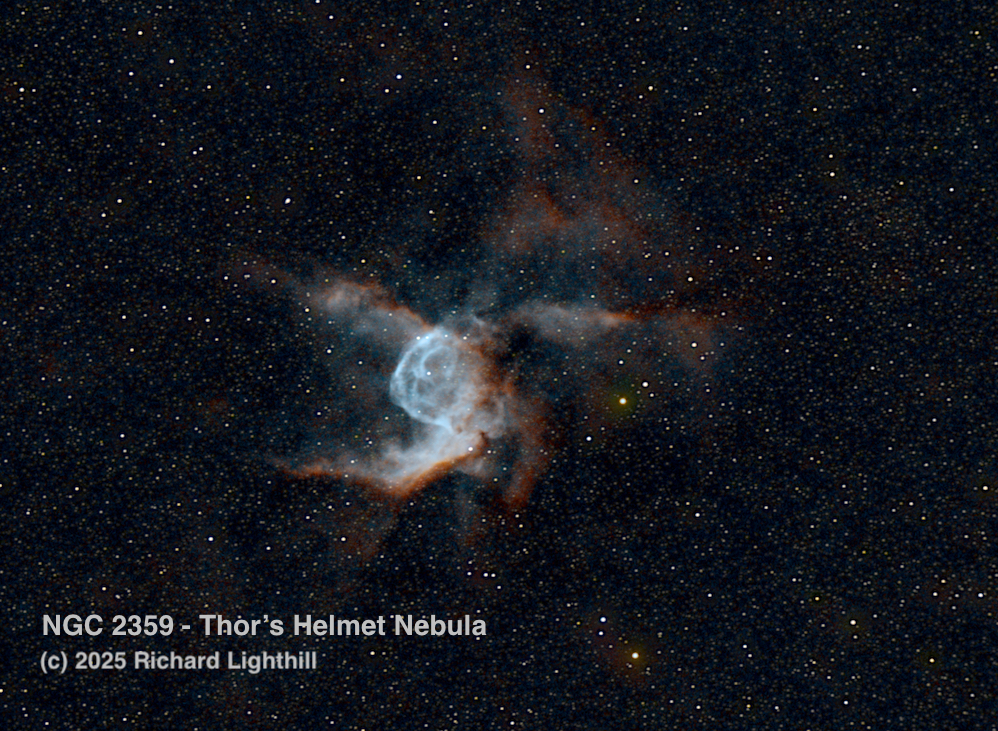
The above is the result of 3 hours of imaging on January 24, 2025 of "Thor's Helmet" nebula (aka NGC 2359) with the ZW0 585MC pro camera, post processed with SIRIL and GIMP. 

Compare it to this one below which I took three years ago on January 24, 2022.:


You can see what a little more experience in imaging and processing with a better camera can do!

Monday, January 20, 2025

The "Hamburger" Galaxy


My only goal was to see how much detail a small refractor could capture in this galaxy...
...not bad but certainly limited ! 

Taken with: 

ZWO ASI585MC Pro USB3 Cooled Color Camera
Daystar 80mm f/6 480mm refractor
About 2.5 hours of integration
Post-processed with SIRIL and GIMP

Sunday, January 19, 2025

M 78 aka the "Casper the Friendly Ghost Nebula"


Now that the Moon is no longer full I was able to spend some time imaging some of the interesting objects around the constellation Orion (which is high in the south-eastern skies when it gets dark at night right now).

This object is known as M 78 to astronomers.

Messier 78 or M78 is a beautiful blue reflection nebula in the constellation Orion. This nebula is often referred to as the ‘Casper the Friendly Ghost Nebula’.
It was discovered by Pierre Méchain in 1780 and included by Charles Messier in his catalog of comet-like objects that same year.
M78 is about 1,350 light-years distant from Earth.
M78 is classified as a reflection nebula because the dust particles in this area are reflecting starlight from the intensely hot, young stars beneath it. About 45 variable stars of the T Tauri type, these young stars still in the process of formation. Due to gravity, the molecular gas in the nebula has broken up into clumps of dust and gases.
Though dim it cann be found with a smaller telescopes at low power as a hazy patch as long as you are viewing this nebula in a sky free of moonlight and city light pollution.
Photography draws out the colors the human eye cannot see. This image was created with a ZWOASI585 MC camera and a 80mm f/6.5 refractor. It is made up of 15 - 240 second exposures made into one image with a total exposure time of about 60 minutes. It was "stacked" with the freeware program SIRIL and post processed with the freeware program GIMP for the final touches.
Can you see that many stars are blocked out of view near the nebula? This is because of how thick the interstellar dust is in that area!
Click on the photo to see a larger view of it.

The "Running Man" Nebula


Taken with: 
ZWO ASI585MC Pro USB3 Cooled Color Camera
Daystar 80mm f/6 480mm refractor
About 2.5 hours of integration
Post-processed with SIRIL and GIMP

Saturday, January 18, 2025

The Flame Nebula


Taken with: 
ZWO ASI585MC Pro USB3 Cooled Color Camera
Daystar 80mm f/6 480mm refractor
About 2 hours of integration
Post-processed with SIRIL and GIMP


Monday, December 30, 2024

Reflection Nebula IC447


My first attempt on a dim reflection nebula, IC447, located in the constellation Monoceros. It includes several massive B-type stars. About 2 hours of integration time at high gain and 60 sec subs using a Daystar 480mm f/6 refractor, duo-band filter and post-processed with Siril. I will have to give this a lot more time in the future as I have over-processed it this time.

Saturday, December 28, 2024

Horsehead Nebula (Barnard 33)


Barnard 33 aka the Horsehead Nebula. Just below the left hand star in Orion's "belt". It was windy but the scope tracked well enough. About 2 hours of one minute exposures with my Daystar refractor.

Friday, December 6, 2024

The Sculptor Galaxy


The Sculptor Galaxy (also known as the Silver Coin Galaxy, Silver Dollar Galaxy, NGC 253, or Caldwell 65) is an intermediate spiral galaxy in the constellation Sculptor. The Sculptor Galaxy is a starburst galaxy, which means that it is currently undergoing a period of intense star formation.- Imaged December 3, 2024

The Region of the Clavius Crater on the Moon

  I photographed this Clavius Region on the Moon's southern hemisphere this evening with a Meade LX200GPS 8" SCT and a monochrome c...